Project Phoenix: Under 110 Grams, Leaked by Meta Itself
Project Phoenix: Under 110 Grams, Leaked by Meta Itself
Meta just leaked its own next headset. Not a supply-chain photo, not a slip from a case maker — the company published the visuals itself, inside a free app on its own Quest store. And the device hiding in there looks nothing like a Quest.
The headset is Project Phoenix: a glasses-style mixed reality device with under 110 grams on your face, the battery and the processor moved into a cable-tethered puck you keep in a pocket, eye and hand tracking as the only input, a field of view reportedly around 90 degrees, and a current plan to launch in the first half of 2027. Meta Connect opens five days from now, on September 23, and that keynote is where this thing finally gets its official version.
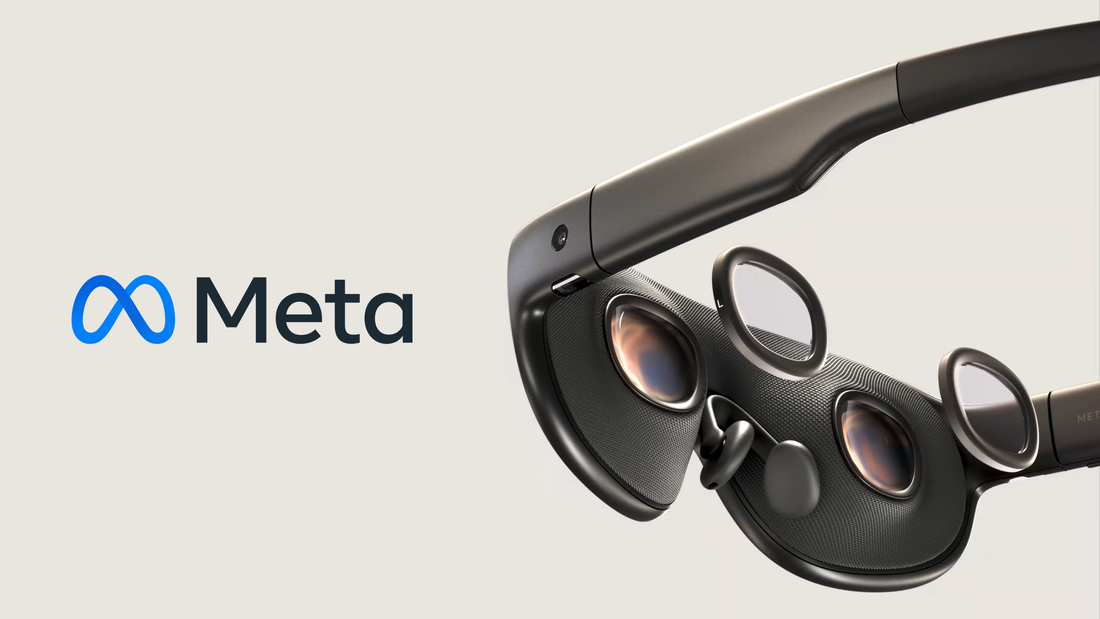
What actually leaked, and why it's embarrassing
The app is called HorizonOS Prescription Lens. It went up on August 13 as a 17 MB “utility” for Quest 2, 3, 3S, and Pro, and it behaves strangely for a store app — it never shows up in your app library, because it's really a system helper for pairing prescription lens inserts. When it first appeared, dataminers found almost nothing inside. One month later, Meta updated it with the real thing: setup visuals showing how Phoenix's lens inserts click in and out, and how you scan a QR card to pair them.
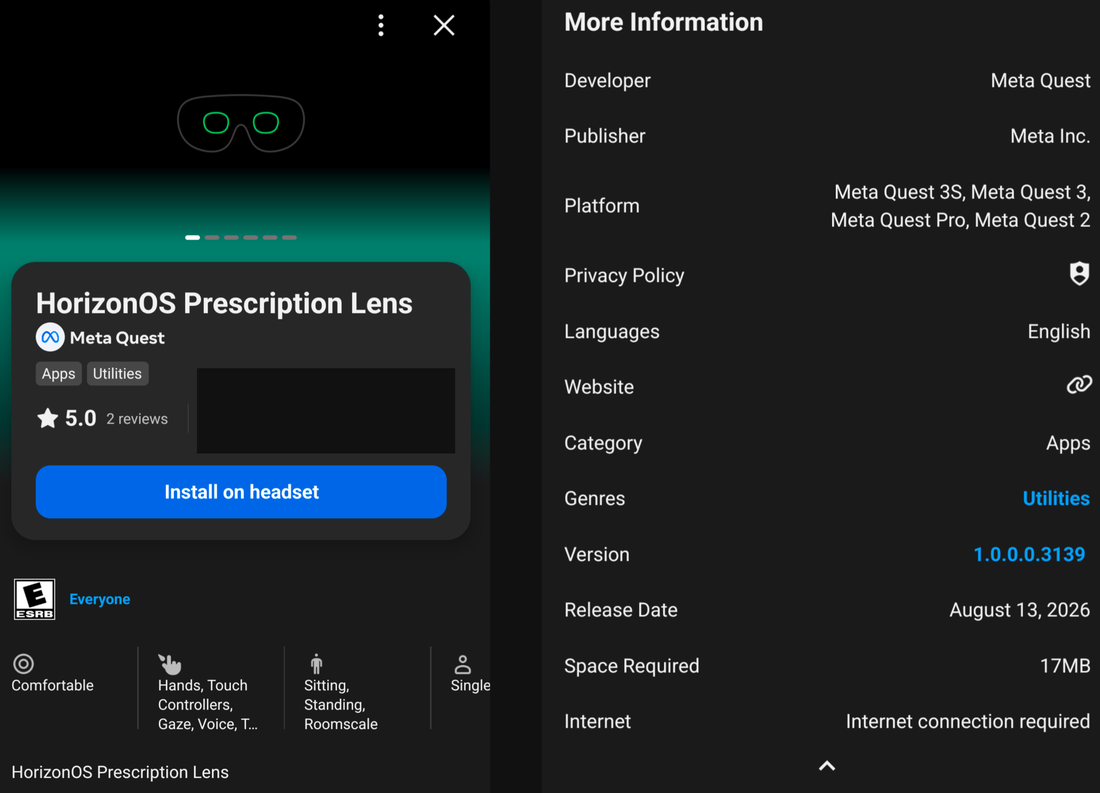
Dataminer and UploadVR contributor Luna published the visuals on September 10, and by the next day the entire XR press was running them. A few things make this leak unusually clean. The images aren't blurry, they're not from a case manufacturer's mockup, and they're not a prototype glimpse — they're finished product artwork, built to be shown to customers. Meta leaked its own marketing.
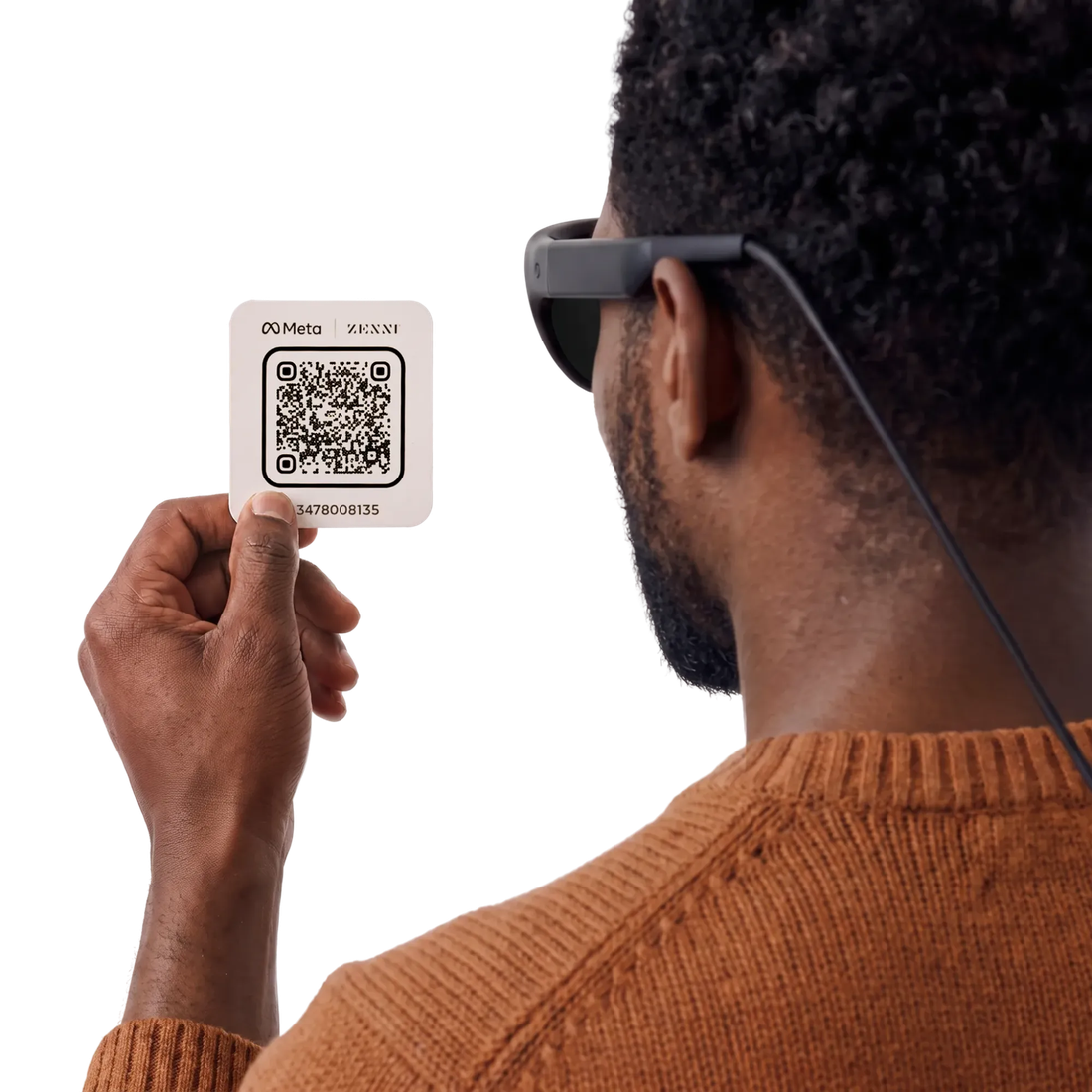
The single best frame of the batch is worth slowing down for. It shows a person from behind, holding a printed card up in front of the glasses — a Meta | ZENNI card with a QR code. In one shot you get the whole architecture: glasses-style nose pads instead of a face gasket, sensors along the outer edge and the underside of the temple arms, and a thin cable leaving the left temple, dropping behind the ear, heading for a puck in a pocket.
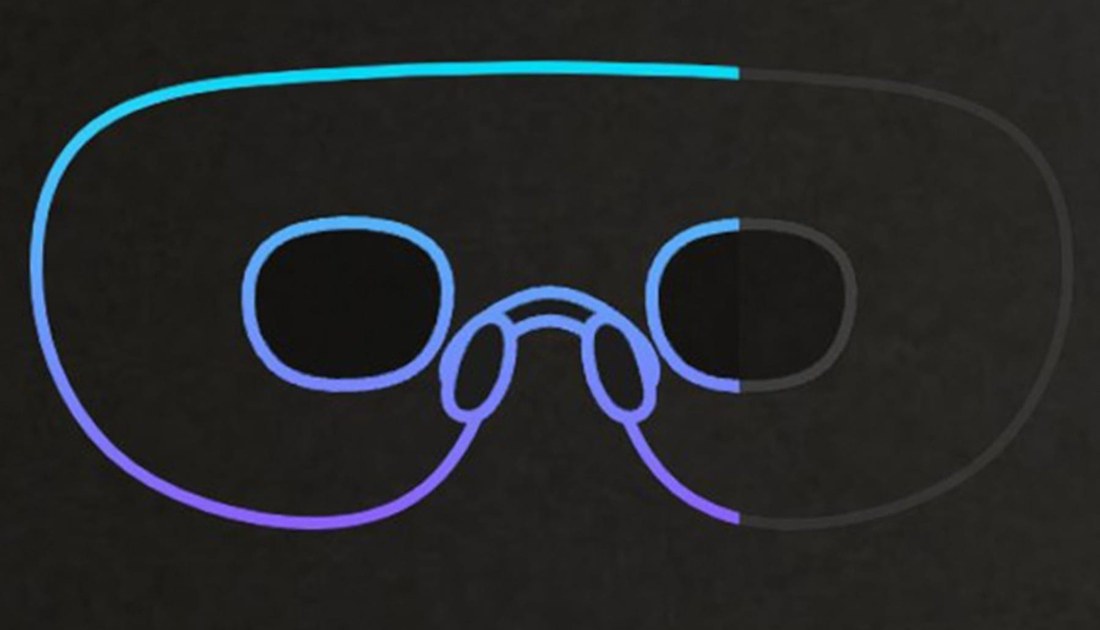
This is also the fourth leak in a year, so pattern recognition is fair. Firmware researchers found the first traces of the device in December 2025 — strings tagged “phx” that Meta quietly removed a week later. In February a dataminer pulled the Eye Tracking setup package out of firmware, and inside it sat a vector outline of a slim headset with nose pads. In late July, a blurry recording of the full setup video leaked. Each installment has been more explicit than the last, and each one survived just long enough to make the round of the internet.

And for scale, here's the leaker's own size comparison from earlier this year — Phoenix's front end next to a Meta Quest Pro. Same company, same job, completely different object:
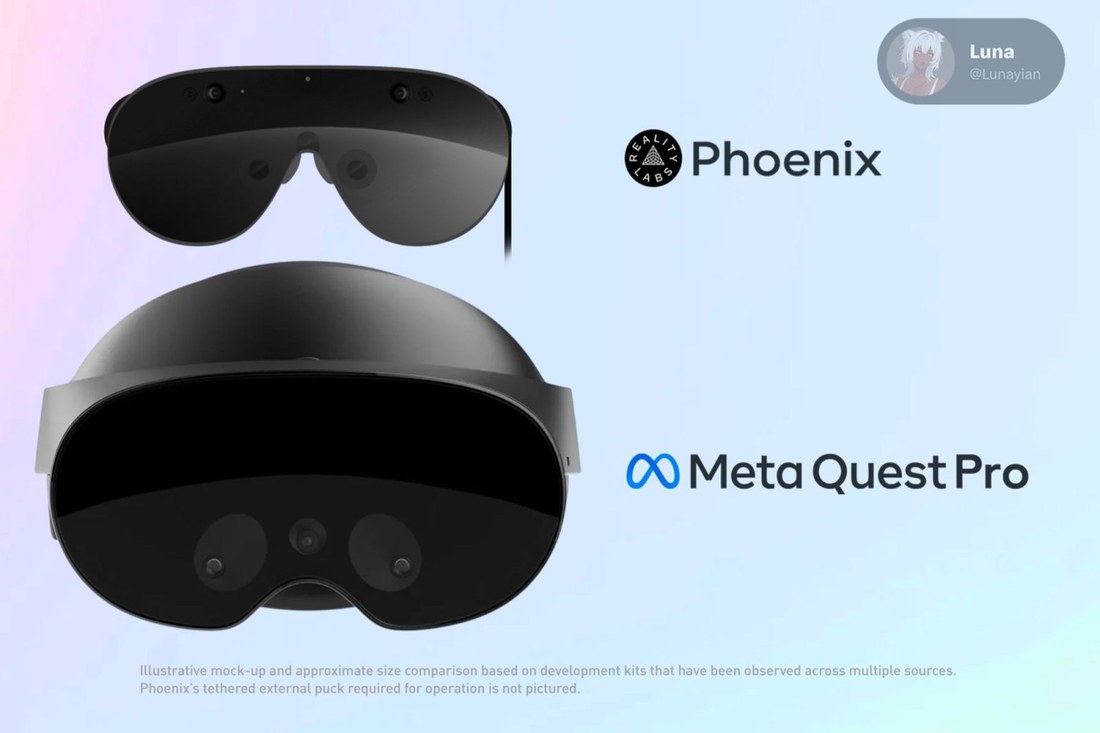
One clarification before the hype gets away from anyone: this is a passthrough mixed reality headset, the same basic principle as a Quest 3 — opaque display, cameras showing you the world around it. It is not see-through AR like Meta's Orion prototype. If Meta ends up marketing it as “MR glasses,” that describes the shape and the fit, not the optics.
What we know — and what we still don't
| Item | What the leaks say | Status |
|---|---|---|
| Weight | Under 110 grams for the part on your face; the pocket puck is extra | Reported target, 2024 → today. Not measured by anyone outside Meta |
| Compute & battery | External, cable-tethered puck — the reason a glasses profile is even possible | Visible in the leaked visuals |
| Field of view | Around 90°, versus roughly 110° on Quest 3 | Leaker-confirmed on X; not official |
| Displays | 2560×2560 micro-OLED per eye | Reported; the supplier claim was disputed |
| Input | Eyes and hands with gaze-and-pinch; no controllers in the setup flow | Firmware strings; Touch controllers seen as optional on dev units |
| Prescription lenses | Zenni inserts, paired by QR card or serial number, required for distortion correction | Leaked visuals |
| Platform | Horizon OS — most Quest Store content should carry over | Firmware evidence |
| Chipset | Snapdragon Reality Elite, on the same reference board as XREAL Aura's puck | Firmware evidence |
| Name | “Pegasus” on a retail-partner calculator page; the URL still says “loma” | Reported |
| Price | Under $1,000 was the 2025 plan; component costs have moved since | Dated report — treat as a floor of expectations, not a price |
| Launch | First half of 2027, with a separate gaming-focused Quest 4 later | Internal memo; not confirmed |
The 110-gram promise, sanity-checked
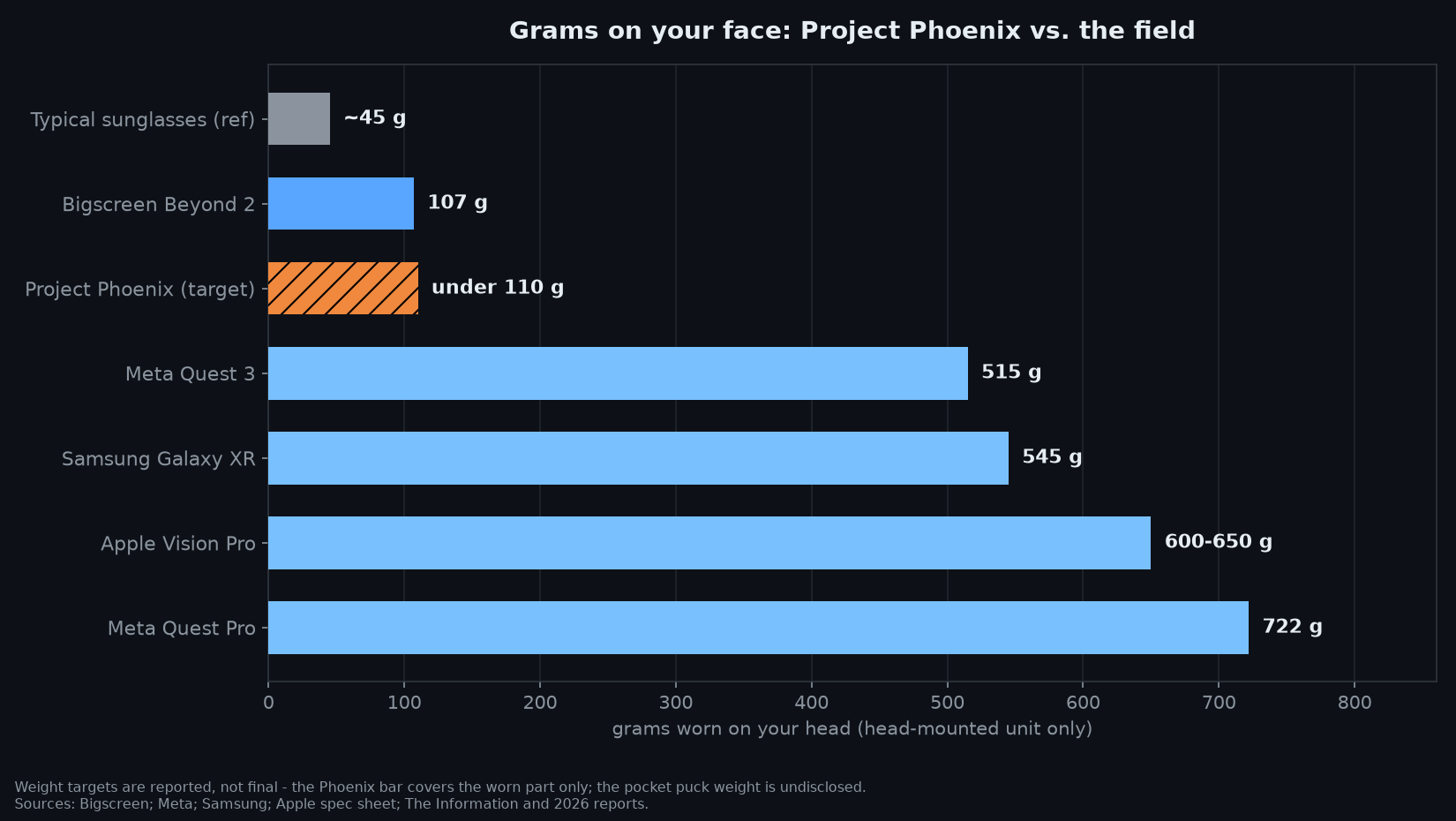
Here's why I believe this number more than I believe most launch rumors. It isn't new — it traces back to 2024 reporting on an early prototype called “Puffin,” described as a “bulky pair of glasses” weighing less than 110 grams — but the rest of the industry has since proven it's possible. Bigscreen's Beyond 2 shipped at 107 grams, with the same class of 2560×2560 micro-OLED panels. The catch: the Beyond 2 is a PC-tethered headset with no cameras, no passthrough, no chip, and no battery. Phoenix has to add all of that and stay in the same weight class. That's the entire reason the puck exists.
I spent time with a 93-gram pair of XR glasses this summer and compared them side by side with my 515-gram Quest 3 (that post is here), and the thing nobody tells you is that grams on your face aren't a linear experience. Past a certain point, every extra gram doesn't add discomfort — it adds awareness. A 515-gram headset is something you wear and think about. A sub-110-gram frame is something you forget. That's the gap Meta is chasing, and it's worth more to daily use than any spec on the box.
The cable is the honest cost of that. Pocketing a battery pack is a genuinely retro move — but the puck isn't just a battery. Vision Pro and Samsung's Galaxy XR offload power only, keeping the processor on your head. Phoenix reportedly sends the chip with it, which is how you get from 500-odd grams to double digits. The trade is real and Meta will hear about it on stage; it's also the only physics available.
About that 90-degree field of view
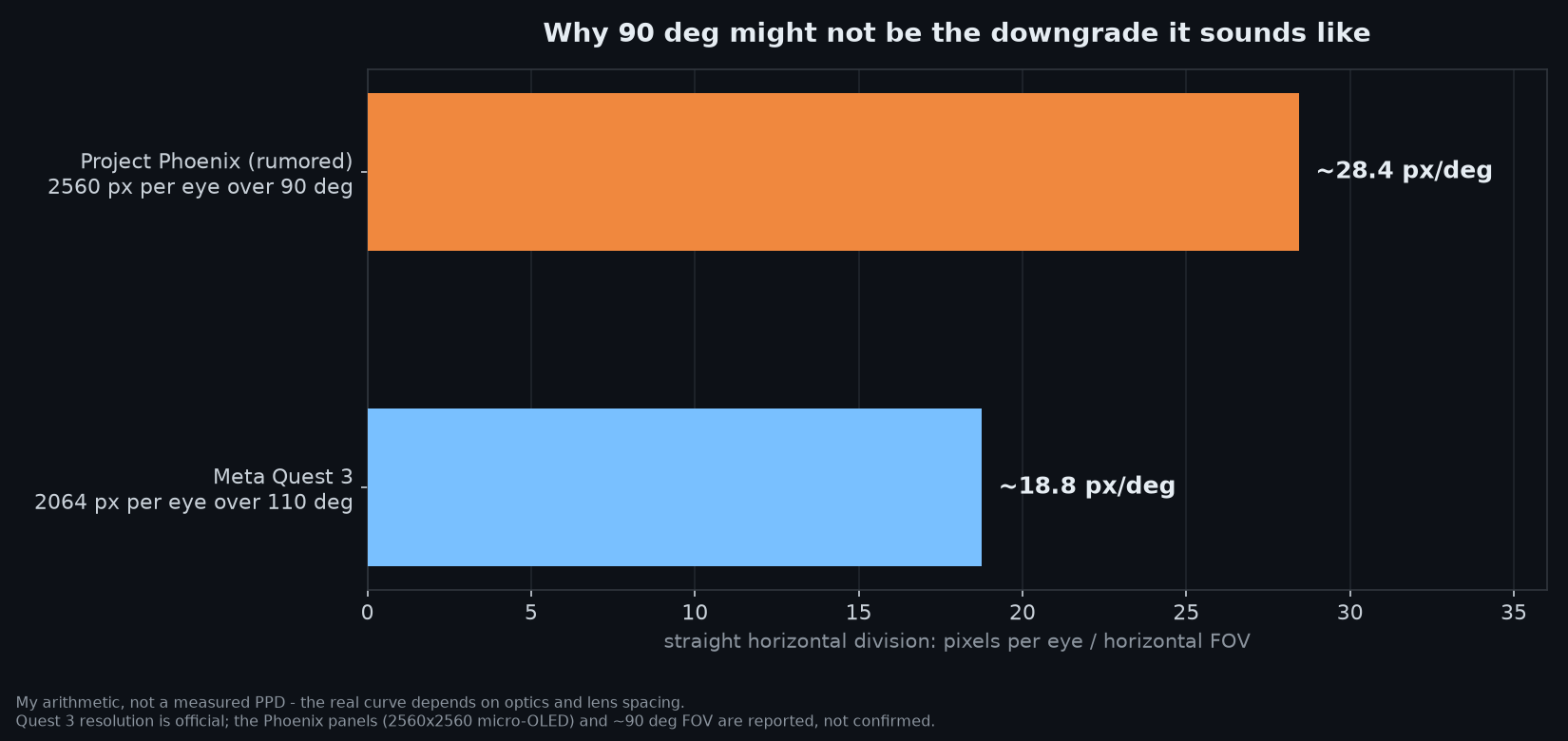
Narrower than Quest 3's ~110 degrees, confirmed by the leaker on X, and the community split within hours of the number landing. The r/OculusQuest thread on the leak is a good sample of both sides:
“Looks like FOV is gonna be terrible.”a top comment on r/OculusQuest
“So, Luna just confirmed on X that FOV will indeed be around 90. Excellent for this form factor!”a reply in the same thread — the opposite camp, two comments later
“All of those HMDs using those panels have an FOV of around 90 degrees. That's the max you're getting out of those panels.”a comment doing the panel math, on the rumored 2560×2560 micro-OLEDs
The panel math is the important part. If the 2560×2560 micro-OLED report is right, then a smaller window isn't purely a downgrade — at 90 degrees, those pixels pack roughly 28 per degree against Quest 3's ~19 (straight division, my arithmetic, not a lab measurement). Text and video look sharper. Black levels and contrast should be micro-OLED good. And 90 degrees is where Quest 2 and Rift S lived — nobody called those unwearable at the time, and the open-periphery design means your real-world vision never stops working at the edges.
Still, one comment in that thread says the thing I keep coming back to: “Phoenix is also supposed to prioritize PPD so anything over 70 FoV would be a pleasant surprise. Binocular overlap is the real question for me.” That's the right skeptical read. A film lover who likes looking around a virtual theater will feel walls at 90 degrees. The sharper-smaller-versus-wider-blurrier trade is real, and it's the exact trade Meta chose on purpose.
Why Meta is even doing this
None of this is an accident, and it isn't really about games. In 2024 Meta canceled the direct Quest Pro successor — codenamed La Jolla — because micro-OLED displays and its other components were too expensive to build to its cost targets. It later shelved the Pismo Quest 4 prototypes too. What survived is the ultralight puck headset, because Meta made a decision to prioritize comfort over specs. CTO Andrew Bosworth said it out loud in a late-2025 AMA, in a way that reads like a mission statement:
“I think lightness is premium on the headset. I think it's more important than a lot of other features. … Instead of taking the wins from each generation and pouring it into more features, you can take those wins and pour it into lightness and smallness, and that's probably the right call.”Andrew Bosworth, Meta CTO, November 2025
The content strategy matches the hardware. Meta has a multi-year partnership with James Cameron to push 3D film and immersive video onto its devices, and reportedly courted Disney and A24 with millions of dollars for made-for-headset series — one of which, a six-episode spin-off of A24's Talk to Me, went into production with a confirmed cast in February. Meta's own games director said it plainly at GDC this year: the next wave of buyers will “purchase VR as a TV replacement first, then discover that it can also play video games.”
So Phoenix isn't a Quest 4. It's the spiritual successor to Quest Pro — a lighter, cheaper-adjacent answer to the Vision Pro playbook, in the lane XREAL and friends have been mining with puck-powered glasses. There's even a firmware breadcrumb connecting the two worlds: the mainboard platform behind Phoenix shares a reference board name with the one in XREAL Aura's Snapdragon Reality Elite puck. Meta isn't inventing a category so much as claiming one.
Not everyone is thrilled about where that leaves VR gaming — one commenter in the leak thread put the grumpy version better than I can: “Why is Meta so focused on these niche XR products… Neither are going to be as mainstream as Quest.” Fair grievance, real strategy. Meta says a gaming-focused Quest 4 is still coming, just later.
What happens Wednesday
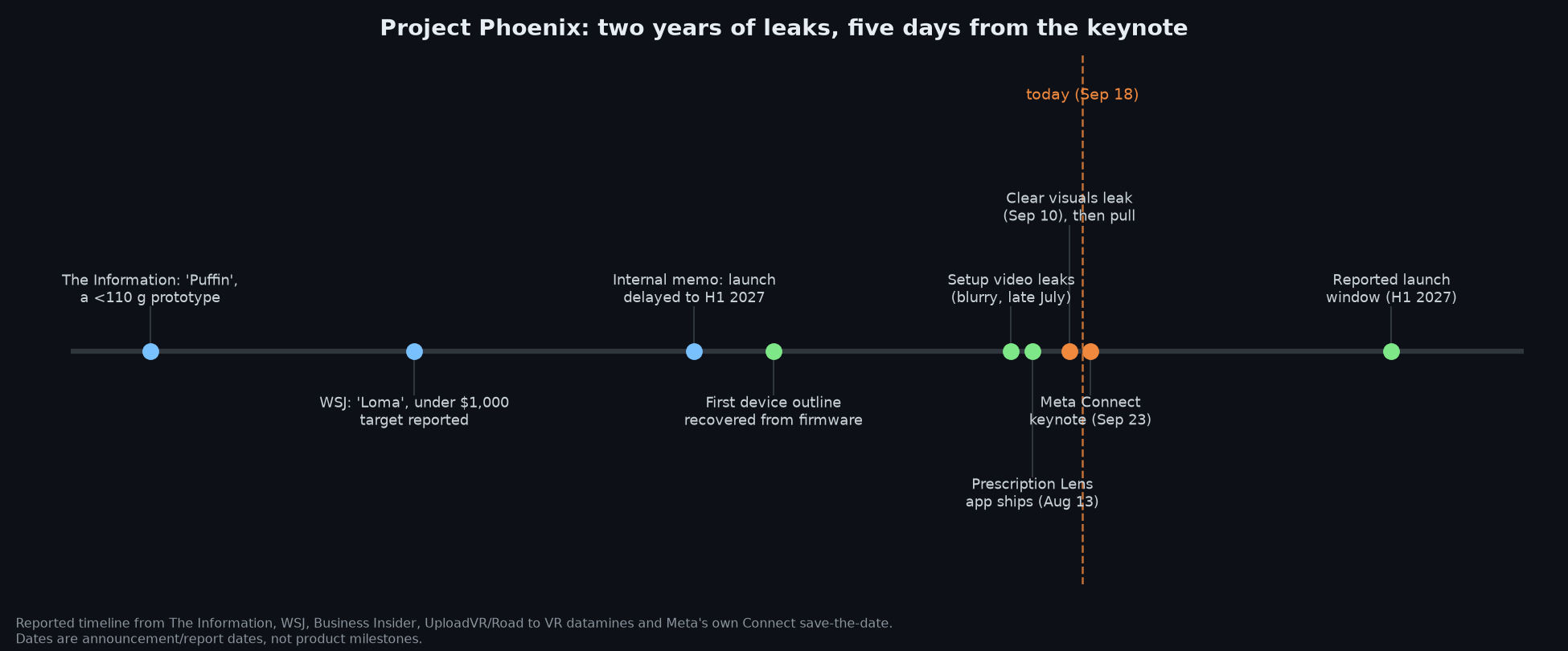
Meta Connect runs September 23–24 at the Menlo Park campus, keynote Wednesday evening Pacific time, and the published agenda includes a session called “A practical guide to controller-free interaction” — which for a headset built entirely around eyes and hands is about as subtle as a wink. The safe expectation, per the roadmap reporting, is a tease or a preview rather than a launch: both of Meta's next headsets point at 2027. The keynote itself is expected to be glasses-led, with the smart glasses line getting stage time alongside whatever headset tease Meta plays. If a name gets said out loud, watch for “Pegasus” — that's what retail-partner pages have been calling it since an August rename.
Then there's the price. The last sourced number is from a 2025 report — Meta internally hoped to come in under $1,000 — and that number has had a rough year, because everything inside a headset got more expensive. DRAM contract pricing is in the middle of the shortage I wrote about this week, and Qualcomm reportedly raised chip prices too. The r/OculusQuest thread has already moved on from the old number: “I don't expect it to be cheap. Memory and components are incredibly expensive. … I'm bracing myself for $900–$1500.” I hope they're wrong. I don't think they are.
Also worth knowing while you wait: Valve's Steam Frame is landing right as Connect opens — Valve's own summer window runs out September 22, the day before the keynote — so Meta will be presenting its future next to a shipping, lightweight, SteamOS competitor. Different audience, same eyeballs.
Should you wait for Phoenix?
If your complaint about your current headset is weight and comfort, and most of what you do is screens, video, and work — this is the first mainstream headset that looks aimed directly at you, and it's broadly the shape I want. Genuinely: wait. Not for the leaks, for the reviews.
If you game actively, roomscale, sweatily, with controllers in both hands — this is not that device. The puck, the open frame, and the narrower field of view all point away from it. Quest 3, Quest 3S, or the Steam Frame are the honest answers there, and nothing in this leak changes that.
And if you're already wearing display glasses — the URXR One crowd, mine included — don't compare them head to head; the URXR One is a display that mirrors your devices, Phoenix is a full computer on your face. I said the same thing in the URXR One post: glasses versus headset isn't the same fight as glasses versus glasses.
My take
This is the most interesting hardware bet Meta has made since the Quest 2, and the leak is the best marketing the company never planned — first-party visuals, free distribution, and a mystery that the keynote now has to answer. The concept is honest: comfort isn't a spec sheet line, it's the thing that decides whether you use the device on day 400 or leave it in a drawer by day 40. Meta is finally optimizing for day 400.
My two asterisks are the same as everyone's: what four-digit price the memory shortage pushes this to, and whether 90 degrees feels like a window or a peephole once it's on my face. Leaked renders always look good on a screen. The only metric that counts is the second hour. I'll be watching the keynote Wednesday, and I'll update this post with the official numbers — price, field of view, launch window — as soon as Meta says them out loud. If a hands-on comes my way, that's a separate post.
Sources: UploadVR (“First Clear Visuals,” the Luna-authored Everything We Know deep dive, firmware and roadmap reporting) · Road to VR (September leak, July setup-video leak) · Android Authority · TechRadar · vr.org (Connect 2026 tracker) · The Information and WSJ reporting via UploadVR/Road to VR · community comments from the r/OculusQuest leak thread (quoted as written, attributed by forum only). Weight references: Bigscreen, Meta, Samsung, Apple published specs.
Disclosure: everything in this post except the r/OculusQuest quotes is sourced from public reporting listed above; specifications described as reported or rumored are not confirmed by Meta, and I'll correct anything the keynote contradicts.
Comments
Post a Comment